GTM means go-to-market. In SaaS and startup work, GTM is the system a company uses to choose a market, define who it serves, explain why the product matters, reach buyers, sell, onboard, and learn from the feedback. It is not only a launch plan. It connects product, marketing, sales, customer success, and revenue operations.
If someone asks "what is GTM?" they usually want the practical version: how a company takes a product from "we built this" to "the right customers understand it, buy it, and keep using it." A strong GTM motion answers four questions:
- Who is the specific customer?
- What pain or job are they trying to solve?
- Which channels can reach them predictably?
- What sales or onboarding motion gets them to value?
Why GTM matters
A product can be good and still fail because the company is talking to the wrong accounts, pricing against the wrong buying process, or choosing channels before it knows where buyers already pay attention.
GTM gives the team a shared model for turning market learning into revenue. It helps a founder decide whether to sell founder-led, hire sales, invest in content, run outbound, build a partner motion, or tighten the product onboarding path. The choice depends on the customer, the category, the deal size, and how much education the market needs.
GTM connects directly to go-to-market strategy. Strategy sets the market thesis and choices. GTM is the working motion that tests those choices with real buyers.
How GTM works
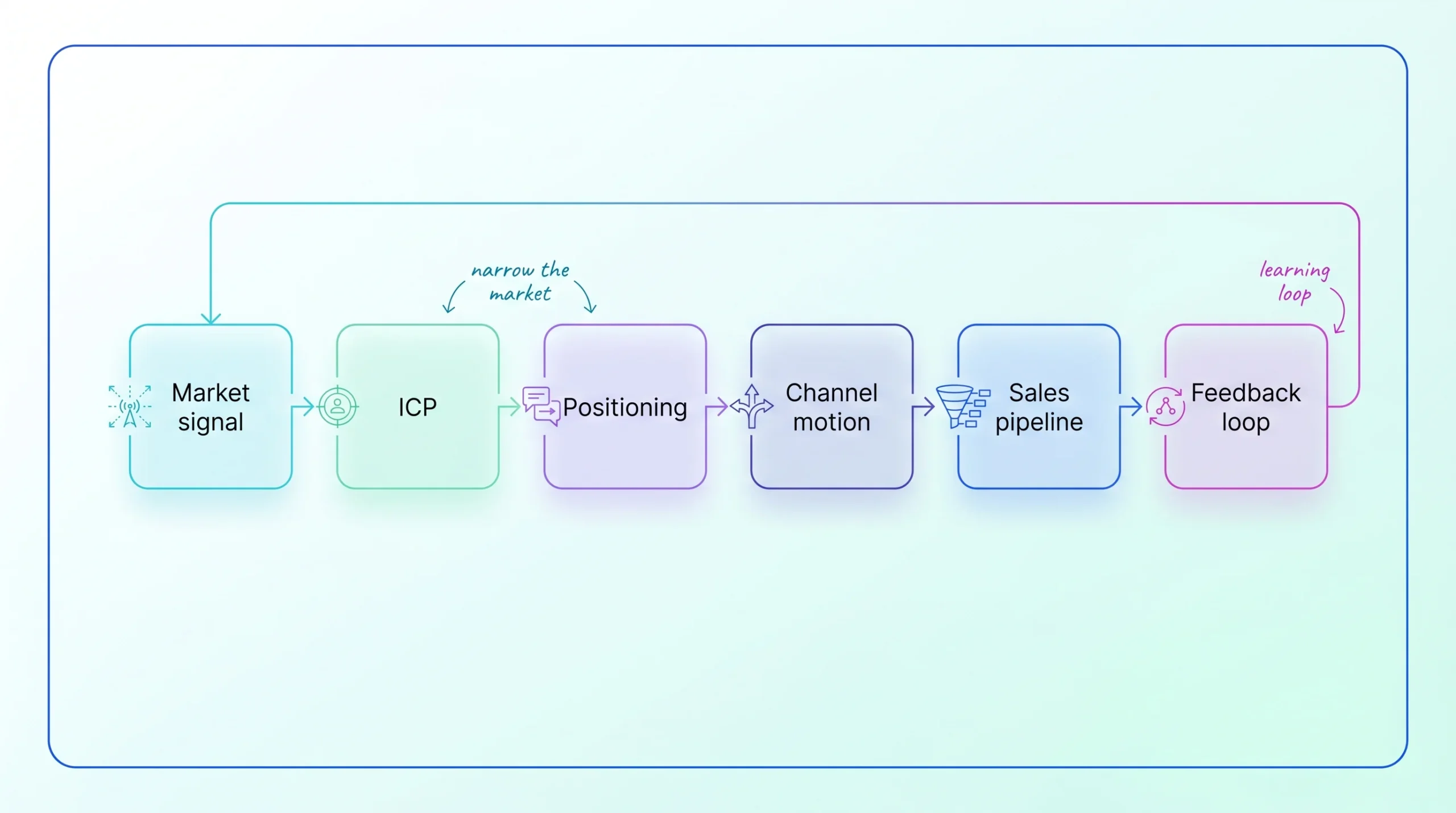
Most GTM systems have five layers.
First, market and segment selection. The team chooses where it will compete instead of chasing every possible buyer.
Second, ICP clarity. The company defines the accounts or users most likely to buy, retain, expand, and teach the team something useful.
Third, positioning. The product needs a clear place in the buyer's head: what it replaces, why it matters now, and what result it makes easier.
Fourth, channel and sales motion. This is the route to the buyer, such as founder-led sales, outbound, content, partnerships, product-led signup, or a mix. The motion should match how the buyer actually discovers, evaluates, and buys.
Fifth, measurement and learning. A GTM team should know which accounts respond, which messages create qualified conversations, where deals stall in the sales pipeline, and what customer feedback should change the next version of the motion.
SaaS example
Imagine a SaaS company selling CRM enrichment to B2B revenue teams. A weak GTM starts with "any company with a CRM." That sounds large, but it gives the team no useful path.
A sharper GTM might start with Series A to C SaaS companies where RevOps owns Salesforce hygiene, outbound depends on account data, and pipeline quality is under pressure. The message is not "better data." The message is that sales teams can stop wasting sequences on accounts that never fit.
From there, the team can pick a channel. It might use outbound to reach RevOps leaders, publish teardown-style content for operators comparing enrichment workflows, and track whether opportunities are cleaner by source. RevOps becomes part of the GTM system, not a separate back-office function.
Common mistakes
The first mistake is treating GTM as a launch checklist. Launch is an event. GTM is the motion before, during, and after the event.
The second mistake is treating GTM as marketing. Marketing may own demand creation, but GTM includes sales, product, onboarding, pricing, customer success, and feedback.
The third mistake is copying a competitor's channel. If a competitor wins through content, that does not mean content is your best first motion. Their category maturity, brand, ACV, team, and customer trust may be different.
How we see it
The useful version of GTM is a learning system.
I care less about whether the deck says PLG, sales-led, founder-led, or outbound. I care whether the company can read a market signal, choose the right account, say something true, and turn the response into a better motion.