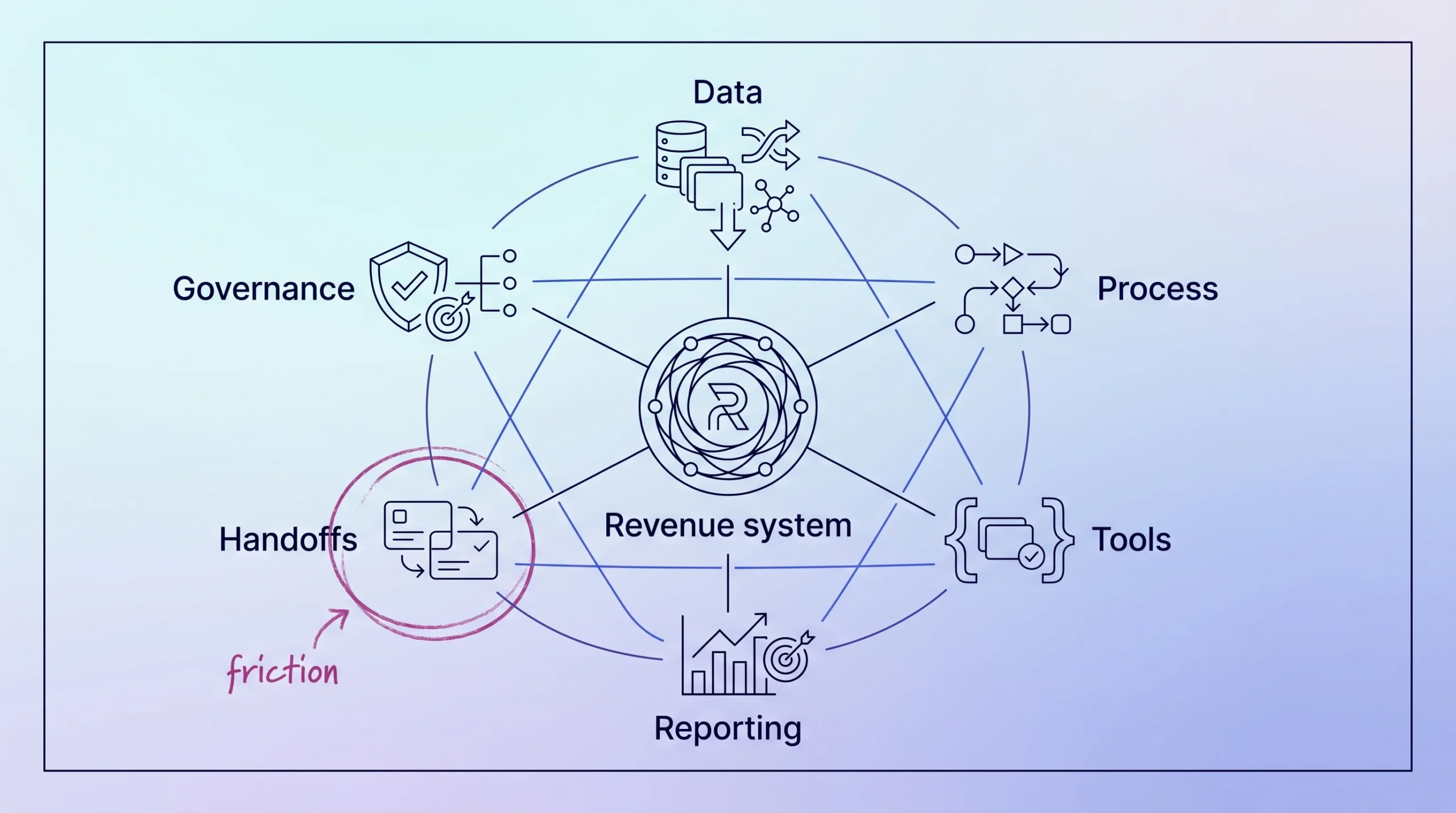
RevOps means revenue operations. It is the function that connects revenue data, process, tools, governance, reporting, and handoffs across marketing, sales, customer success, and finance.
In SaaS, RevOps helps the revenue team run on shared definitions. It keeps CRM data usable, lifecycle stages clear, routing rules consistent, attribution understandable, forecasts cleaner, and customer handoffs less chaotic.
RevOps is not only tool administration. Tools are part of the job, but the deeper work is making the revenue motion reliable enough for people to trust.
Why it matters
Revenue teams break when each function uses a different version of the truth. Marketing counts leads one way. Sales qualifies another way. Customer success inherits missing context. Finance sees forecast gaps late. Leadership asks for reports that the system cannot answer.
RevOps reduces that drag. It gives the GTM motion a cleaner backbone: definitions, data fields, automation, workflows, source tracking, and reporting. It also helps teams see whether pipeline, conversion, retention, and expansion are improving for real.
For startups, RevOps often starts before there is a RevOps hire. A founder, sales leader, or GTM engineer may own the first version.
That early version still matters. If the company waits until the CRM is already messy, every later report, handoff, and automation has to fight old assumptions.
How it works
RevOps usually works across six layers.
First, data architecture: fields, objects, source tracking, deduplication, and data hygiene.
Second, process: lifecycle stages, qualification rules, handoff rules, and sales process.
Third, systems: CRM, marketing automation, enrichment, sequencing, support, billing, and reporting tools.
Fourth, governance: who can change what, which definitions are official, and how changes are documented.
Fifth, reporting: dashboards, pipeline reviews, funnel analysis, forecast views, and retention metrics.
Sixth, enablement: making sure reps and managers use the process without fighting the system.
SaaS example
Imagine a SaaS company where SDRs book meetings, account executives run deals, and customer success manages onboarding. If lead source, qualification, demo outcome, close reason, and handoff notes are inconsistent, leadership cannot tell what is working.
RevOps would define the lifecycle stages, clean required fields, route accounts by ownership, standardize opportunity stages, and build reporting around the sales pipeline. It may also set rules for when accounts move back to nurturing or customer success.
Common mistakes
The first mistake is treating RevOps as a help desk for tools. That creates reactive ticket work but no system improvement.
The second mistake is adding automation before definitions are clean. Bad routing moves faster when the data is unclear.
The third mistake is separating RevOps from market learning. If ICP quality or deal quality is changing, the revenue system should show it.
How we see it
RevOps should make the revenue team easier to run. The strongest RevOps work is usually invisible when it works: fewer messy handoffs, fewer arguments about numbers, and faster answers when the market changes.