A go-to-market strategy is the set of choices a company makes about which market to pursue, which customer to serve, how to position the product, which channels to use, how to sell, and how to learn from buyer response. It turns a broad GTM idea into a focused operating plan.
For a SaaS startup, the strategy should answer a simple question: where can this product win with the team, proof, pricing, and timing it has right now?
That means go-to-market strategy is less about a slide deck and more about tradeoffs. A company chooses one segment before another. It picks a channel because buyers already pay attention there. It shapes the sales motion around how the buyer evaluates risk. It defines the signals that will tell the team whether the motion is working.
Why it matters
Without go-to-market strategy, teams usually drift into activity. Marketing publishes content for a vague audience. Sales builds lists that are too broad. Product hears scattered feedback. Founders read every competitor move as a new priority.
A clear strategy gives the team a sharper path. It sets the customer profile, the message, the buying process, the channel mix, and the feedback loop. That does not guarantee growth, but it gives the company a way to learn from the market instead of arguing from opinion.
For early SaaS teams, the value is focus. A strong strategy may say: sell to RevOps-led Series B SaaS teams first, use outbound and founder-led calls, lead with pipeline quality pain, and measure meetings that turn into qualified opportunities. That is far more useful than "sell to B2B companies."
How it works
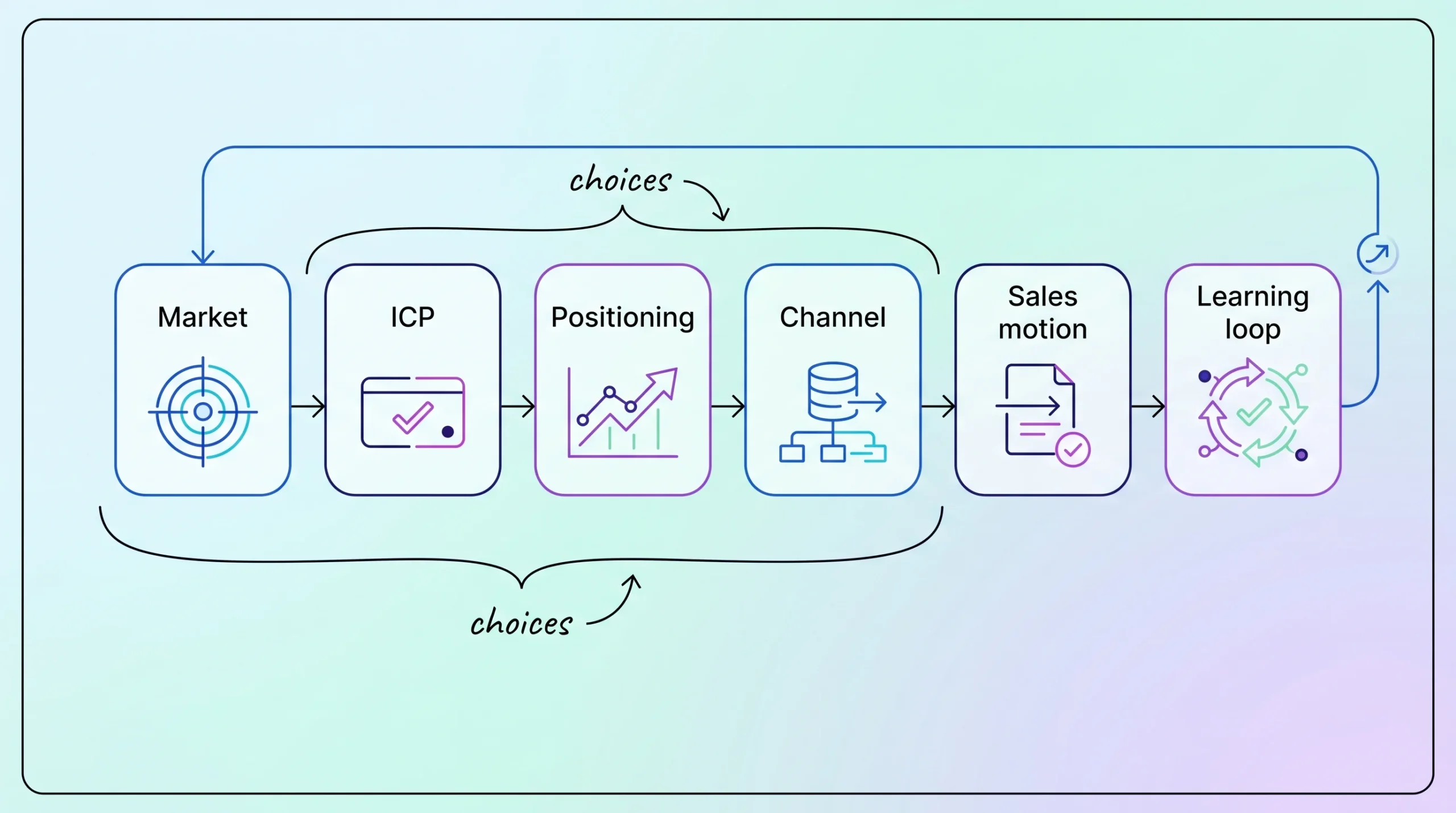
A go-to-market strategy usually has six connected decisions.
First, market selection. The team chooses the segment where the pain is clear and the product has a credible wedge.
Second, ICP. The company defines the accounts most likely to buy, retain, expand, and teach the team.
Third, positioning. The product needs a clear place in the buyer's head: what it replaces, why now, and why this vendor.
Fourth, channel. The company chooses how it reaches buyers, such as founder-led sales, outbound, content, partnerships, product-led signup, or events.
Fifth, sales motion. The company defines how buyers move from interest to purchase, including qualification, discovery, proof, pricing, procurement, and handoff.
Sixth, learning loop. The team uses pipeline quality, win/loss feedback, activation, retention, and sales notes to improve the strategy.
SaaS example
Imagine a startup selling AI call review software. A weak strategy says "we help sales teams coach reps." That market is large, but the team still does not know who to target first.
A sharper strategy might start with mid-market SaaS companies where sales managers own onboarding quality, call volume is high, and new-hire ramp time is painful. The message becomes "reduce ramp time by finding coachable moments faster." The first channel might be outbound to sales leaders, supported by operator-style teardown content. Sales pipeline quality becomes the feedback signal.
Common mistakes
The first mistake is confusing strategy with a campaign calendar. Campaigns are execution. Strategy explains which buyers and motions deserve execution.
The second mistake is copying another company's channel. A competitor's content motion may work because of brand, category maturity, or a larger team.
The third mistake is skipping RevOps too long. Even a simple strategy needs clean routing, source tracking, and feedback from closed-won and closed-lost deals.
How we see it
A go-to-market strategy should make the company easier to disagree with. If nobody can tell what market, buyer, channel, and motion you are betting on, the strategy is too soft.